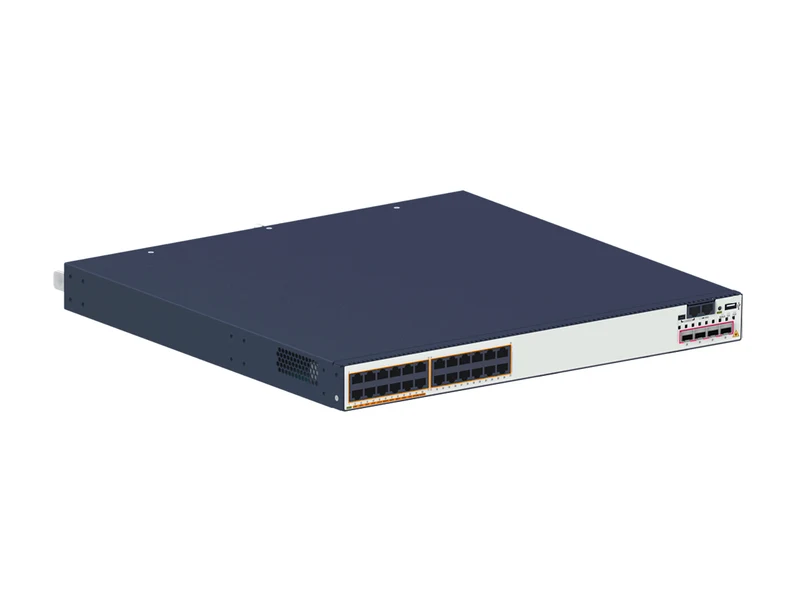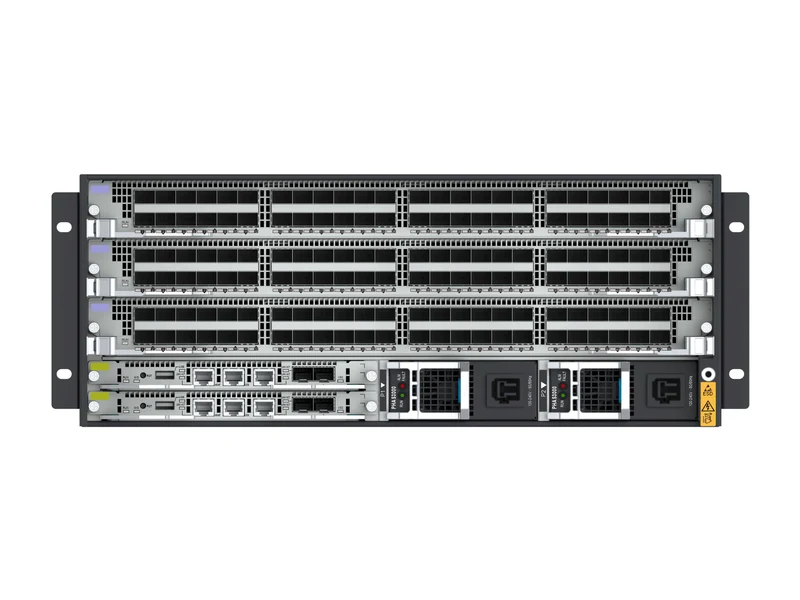
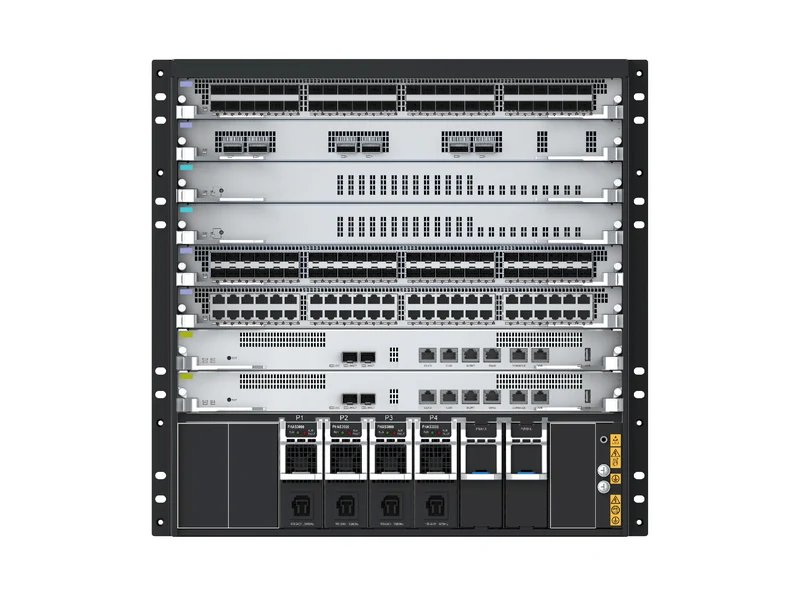
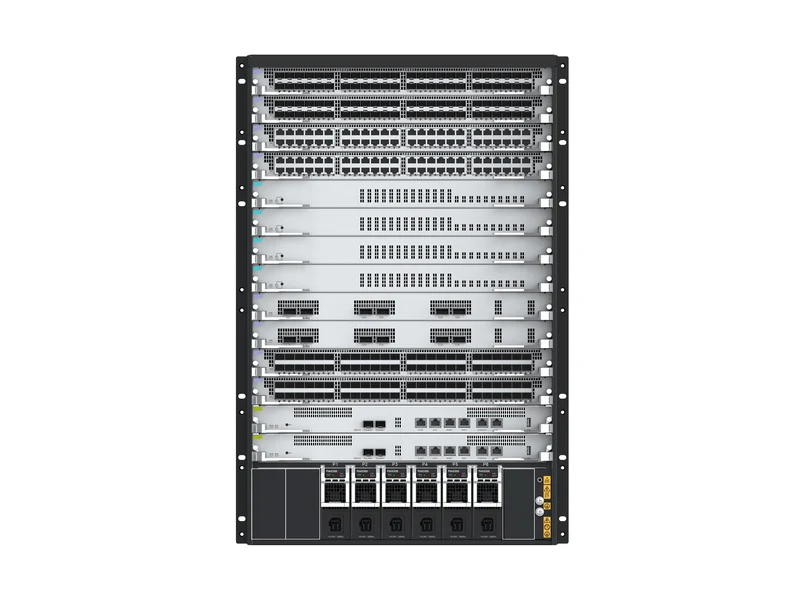
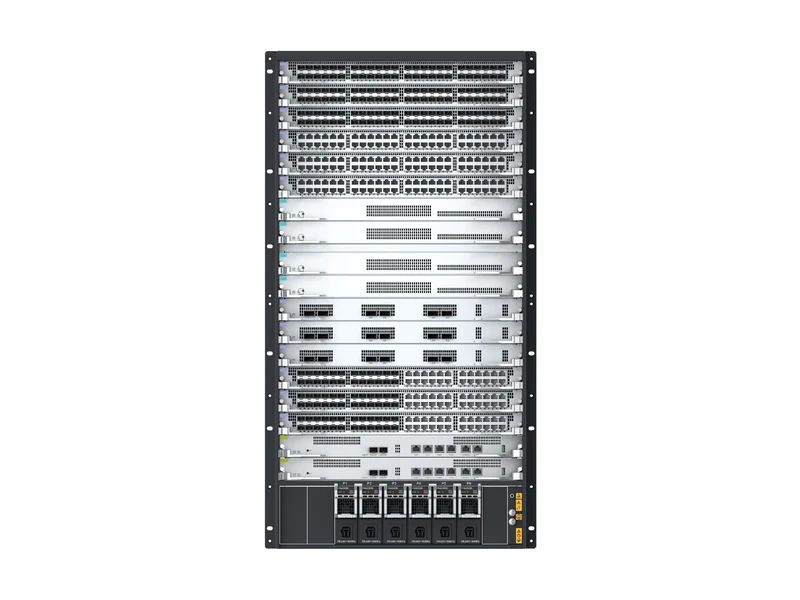


CLOS non-blocking modular core for campus and metro networks — four chassis from the 4U S7850-3 (3 service slots) to the 20U S7850-12 (12 service slots), with interface boards from gigabit copper to 6×100GE, M+N power redundancy and VSE 2.0 clustering. We engineer the slot-by-slot configuration around your port plan and deliver it with the rest of the network.
Sample quantities are welcome — testing one or two units first is the normal way to start.
The ZXWT S7850 series is the chassis core of the ZXWT campus family, built for the core and aggregation layers of government, finance, utility, transport, campus, hospital and commercial park networks, as well as campus data centers and new-generation metro networks. The architecture is CLOS non-blocking with cell switching for load balancing, on fully programmable NP chips. All models separate main control from switching fabric, share the same interface boards (48×GE copper/fiber and PoE boards, 8/16/24/48-port 10GE boards, 6-port 40GE and 6-port 100GE/40GE boards), and take M+N power redundancy up to 3+3. VSE 2.0 clustering stacks chassis up to 80 km apart with 1.6 Tbps of stacking bandwidth and zero-perception switchover. This page lists the current four-chassis lineup — S7850-3, S7850-4, S7850-8 and S7850-12 — with figures quoted from the manufacturer's February 2026 datasheet only.
Interface boards are interchangeable across all four — grow the chassis, keep the boards.
Plain-language guide — based only on what this series actually does.
For corporate buyers: we support submitting the purchase order to the manufacturer under your company's real name — your company appears on the official order, so the origin of the goods can be verified directly with the factory. Just provide your company name and pay by corporate bank transfer.
For small and mid-size orders, we deliver directly to your designated forwarder's warehouse in China (EXW / FOB Guangzhou). From hand-over onward, international shipping and destination-side arrangements are handled by your forwarder — the way you already work.
The series capability list — from the manufacturer's datasheet.
Series specifications with one column per model — technical values in English. The highlighted column follows your model selection above.
| S7850-3 | S7850-4 | S7850-8 | S7850-12 | |
|---|---|---|---|---|
| Switching capacity | 168 Tbps | 387 / 1161 Tbps | 645 / 1935 Tbps | 1290 / 3870 Tbps |
| Packet forwarding rate | 36800 Mpps | 115200 Mpps | 230400 Mpps | 460800 Mpps |
| Chassis height | 4U | 11U | 16U | 20U |
| Chassis dimensions (W×D×H, mm, excl. mounting ears) | 444×502.5×175 | 442×504×465 | 442×504×709 | 442×504×886.2 |
| Total slots | 5 | 8 | 14 | 18 |
| Main control (MCU) slots | 2 | |||
| Switching fabric slots | / | 2 | 4 | 4 |
| Service slots | 3 | 4 | 8 | 12 |
| Fan modules | 1 | 2 | 4 | 5 |
| Power redundancy | 1+1 | 2+2 | 3+3 | 3+3 |
| S7850-3 | S7850-4 | S7850-8 | S7850-12 | |
|---|---|---|---|---|
| DC power | Rated −48 V DC / −60 V DC; max range −38 V DC to −72 V DC | |||
| AC power | Rated 110 V AC / 220 V AC, 50/60 Hz; max range 90–290 V AC, 45–66 Hz (at 90–175 V AC input, output derates to 45% of full load) | |||
| High-voltage DC | Rated 240 V DC / 380 V DC; max range 192–400 V DC | |||
| S7850-3 | S7850-4 | S7850-8 | S7850-12 | |
|---|---|---|---|---|
| Interface board types | 48-port GE PoE copper / 24-port GE copper / 48-port GE fiber / 48-port GE copper / 6-port 100GE/40GE fiber / 24-port GE fiber / 48-port 10GE fiber / 6-port 40GE fiber / 16-port 10GE fiber / 8-port 10GE fiber / 24-port 10GE fiber | |||
| L2 features | VLAN, flexible QinQ, VLAN translation, STP/RSTP/MSTP | |||
| L3 features | VRRP, SuperVLAN, DHCP Server/Relay/Snooping, static routing, RIP, OSPF, IS-IS, BGP, policy routing, MCE | |||
| MPLS / MPLS VPN | LDP, VPLS, VPWS, H-VPLS, MPLS L3VPN, multicast VPN | |||
| Multicast | IGMP Snooping/Proxy, IGMP, PIM-DM/SM, PIM-SSM, MSDP | |||
| QoS | 802.1p, IP DSCP and MPLS EXP marking, rewriting and mapping / 8 hardware queues per port / SP, WRR, SP+WRR scheduling / port- and flow-based bandwidth management / tail drop and WRED congestion avoidance | |||
| Security | CPU anti-attack and overload protection, broadcast/multicast/unknown-unicast suppression, STP Root Guard, BPDU guard, uRPF, RIP/OSPF/BGP MD5 authentication, IP Source Guard, DAI, 802.1x / Portal / MAC authentication | |||
| IPv6 | IPv6, ND, DHCPv6, PMTU, MLD Snooping / static routing, RIPng, BGP4+, OSPFv3, IS-ISv6 / manual tunnels, 6to4, 6PE, ISATAP / IPv6 ACL / IPv6-based device management | |||
| Reliability | Redundant MCU, power and fan boards / LACP, MC-LAG, ERPS, VRRP, FRR, NSF, GR, VSE stacking, BFD | |||
| Data center features | VxLAN, BGP-EVPN, VxLAN OAM, VxLAN ping, VxLAN tracert | |||
| SDN | NETCONF and YANG models; automated deployment and policy follow-on | |||
| Device management | RS232 console (RJ45), out-of-band management port, CLI, Telnet, SSH, local & remote (RADIUS/TACACS+) AAA, SNMP, MIB, RMON, Syslog, fast batch inspection tools | |||
| O&M | 802.1ag, 802.3ah, Y.1731, zero-touch deployment, vertical virtualization, sFlow, Telemetry | |||
| Operating environment | Long-term 0°C to +45°C, short-term -5°C to +50°C, humidity 5%–95% | |||
| MTBF / MTTR | > 250000 h / < 30 min | |||