

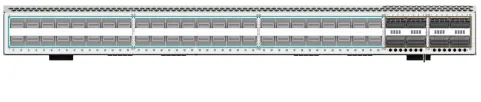
ZTE Wantong S6850-X · 10G/25G Data Center
1U fixed-port switches with 48 SFP+ or SFP28 ports and 40G/100G uplinks for server and storage racks, aggregation of 10G-uplink access switches, and the core of mid-size campus networks — with MC-LAG, EVPN VXLAN, BGP/IS-IS and 1+1 hot-swap power. We deliver them configured as part of the network solutions we build.
Lead time · In stock: at your forwarder’s China warehouse 3 days after payment · Not in stock: 7–15 working days · Then air 5–10 days / sea 25–45 days to your port
Terms · Sample orders welcome · Quotation / PI fixes models, prices, Incoterms (EXW or FOB, each quoted separately), lead time and T/T payment · Defective units: free spare units agreed per order (quantity depends on order size) and written into the quotation · Warranty: up to 5 years on Zhongxin Shutong industrial switches, manufacturer warranty on other brands · Full terms, warranty & RMA
Need the PDF datasheet? Get it on WhatsApp →Sample quantities are welcome — testing one or two units first is the normal way to start.
The ZTE Wantong S6850-X series is the fixed-port 10G/25G layer of the ZTE Wantong switching family, sitting between the gigabit access and aggregation lines and the S7850 chassis core. All three models share one 1U chassis (442×420×43.6 mm) with four hot-swap fans, front-to-back airflow and two modular power supplies in 1+1, available as AC, −48 V DC or 240/336 V high-voltage DC. The S6850-XE and S6850-XD carry 48×10GE SFP+ with 40GE or 100GE uplinks at 2000 Mpps; the S6850-XQ carries 48×25GE SFP28 with 8×100GE at 3200 Mpps. Software covers static/RIP/OSPF/IS-IS/BGP routing for IPv4 and IPv6, ECMP, VRRP, BFD, MC-LAG and EVPN VXLAN. Specifications below are quoted from the manufacturer's datasheet — fields it does not publish are left out.
One chassis, two port speeds
How the three models split the job — so you pay only for the port and uplink speed the project needs.
Is this the right 10G/25G series for you?
Plain-language guide — based only on what these switches actually do.
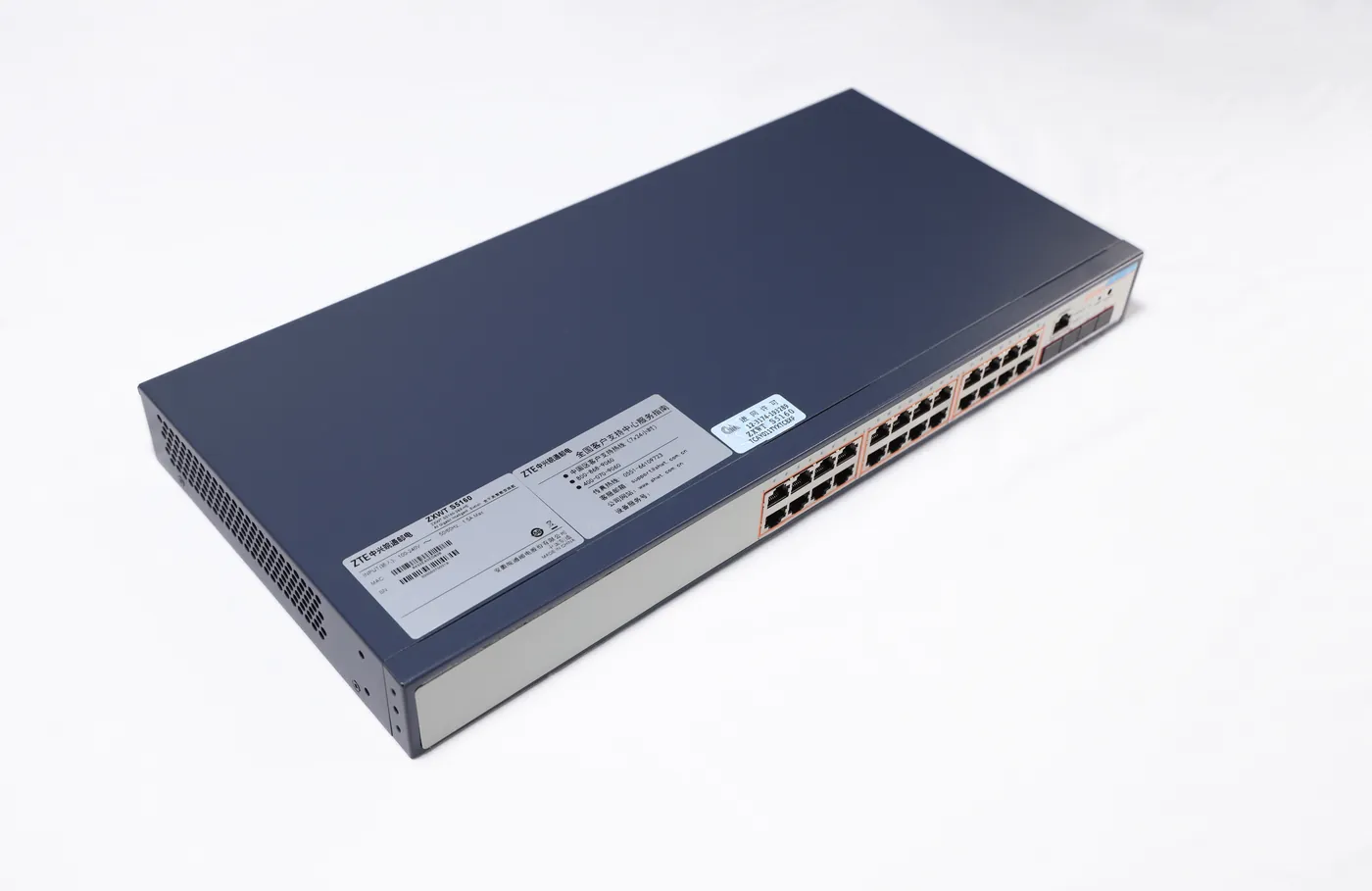
- RJ45 desk ports or PoE for cameras and APs — that is the access layer: ZTE Wantong S5150 or S5160-HE (with 10G uplinks)
- Gigabit aggregation with a few 10G uplinks on a smaller budget — the ZTE Wantong S5860-E or S5860-S series
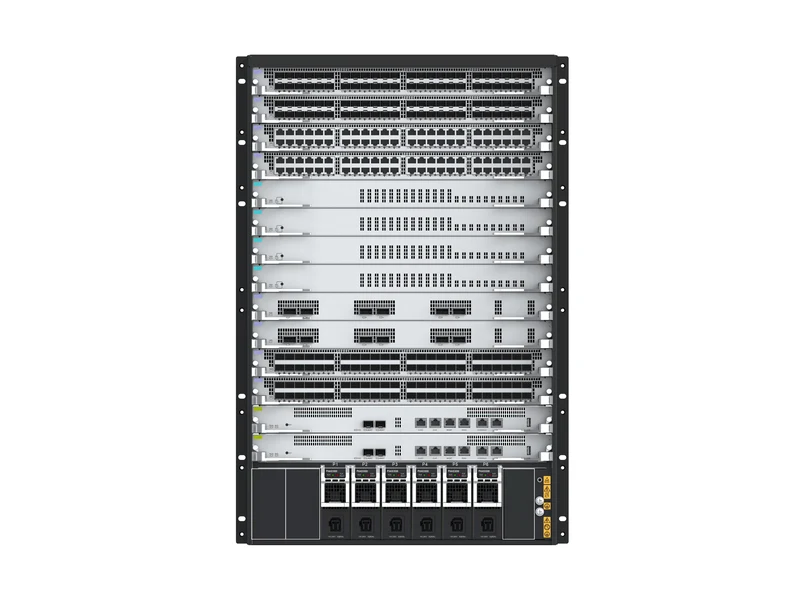
- A large core with line cards and many service slots — the ZTE Wantong S7850 chassis core series
Worried about the source? Order under your own company name.
For corporate buyers: we support submitting the purchase order to the manufacturer under your company's real name — your company appears on the official order, so the origin of the goods can be verified directly with the factory. Just provide your company name and pay by corporate bank transfer.
Using your own freight forwarder? No problem.
For small and mid-size orders, we deliver directly to your designated forwarder's warehouse in China — EXW or FOB, your choice, each quoted separately. From hand-over onward, international shipping and destination-side arrangements are handled by your forwarder — the way you already work.
Key Features
The series capability list — from the manufacturer's datasheet.
Who uses it, where it goes and how to plan the 10G/25G layer
Written for the ZTE Wantong S6850-X series from its own specifications: 3 models with 48×10GE SFP+ or 48×25GE SFP28 ports, 6×40GE, 6×100GE or 8×100GE uplinks, 2000–3200 Mpps, MC-LAG, EVPN VXLAN and 1+1 hot-swap power.
Who it is for
- Network integrators building campus aggregation and core — A pair of S6850-XE or XD units in MC-LAG with VRRP gateways collects the 10G uplinks of every building's access switches and routes between their VLANs with OSPF or IS-IS, in 2U of rack space.
- Server room and data center operators — Top-of-rack for 10G or 25G servers and storage, dual-homed with MC-LAG, uplinked at 40G/100G to the spine, with EVPN VXLAN for tenant separation and Netconf for SDN controllers.
- Video surveillance centers and safe-city projects — Aggregates the 10G uplinks of camera access switches and feeds NVR, video storage and analytics servers at 10G or 25G; 8 hardware queues per port and WRED help keep video flows apart from other traffic.
- ISPs and carriers — -40 V to -72 V DC or 240/336 V HVDC power for telecom rooms, BGP4/BGP4+ and IS-IS for peering with the operator's network, and QinQ, VLAN translation and MCE to keep customers separated.
Where and how to install
- Rack in an equipment room — All three models are 1U, 442 mm wide and 420 mm deep, so they need a 19-inch rack with enough depth for the switch plus fibre and power cable bend room at both ends. A shallow wall cabinet is usually too short; plan a floor-standing equipment or server rack.
- Airflow and temperature — Airflow is strictly front-to-back, so mount the switch facing the same way as the servers in the row and keep the cold aisle at the intake side. The rated range is -5°C to 40°C and 10%–90% RH non-condensing: install it in an air-conditioned room, not in an outdoor or roadside cabinet.
- Power feeds — Fit both power modules and connect them to two separate feeds (two PDUs, or AC plus DC where the room has both), so a breaker trip or a module failure does not stop the switch. In telecom rooms use the -40 V to -72 V DC or 240/336 V HVDC modules; elsewhere AC 100–127 V or 200–240 V.
- Optics and fibre — Every service port is a cage: SFP+ (10G) on the XE and XD, SFP28 (25G, or 10G) on the XQ, QSFP+ (40G) or QSFP28 (100G, or 40G) for uplinks. Inside the rack, direct-attach cables are the usual choice; between rooms or buildings use fibre, with the same module type and wavelength at both ends of each link.
- Management network — Connect the GE out-of-band management port to a separate management switch so you can still reach the unit if the data network fails, use SSH and SNMP v3 with RADIUS or TACACS+ login, and keep a console cable for the RJ45 console port in the rack for first setup and recovery.
S6850-X series planning: which of the 3 models
All three share the same chassis, power and software; they differ in downlink speed, uplink speed and how much uplink bandwidth sits behind the 48 ports. Oversubscription here is simple arithmetic: total downlink bandwidth ÷ total uplink bandwidth with every port at its full rate. Below 1:1 the uplinks can carry everything the downlinks send; 2:1 means the uplinks fill up when all downlinks run above half load at the same time.
| XE | XD | XQ | |
|---|---|---|---|
| Downlink ports | 48×10GE SFP+ | 48×10GE SFP+ | 48×25GE SFP28 (or 10GE) |
| Uplink ports | 6×40GE QSFP+ | 6×100GE QSFP28 (or 40GE) | 8×100GE QSFP28 (or 40GE) |
| Total downlink bandwidth | 480 Gbps | 480 Gbps | 1200 Gbps (480 Gbps at 10GE) |
| Total uplink bandwidth | 240 Gbps | 600 Gbps | 800 Gbps |
| Oversubscription (downlink ÷ uplink) | 2:1 | 0.8:1 | 1.5:1 (0.6:1 at 10GE) |
| Switching capacity | 4.8 Tbps / 96 Tbps | 4.8 Tbps / 96 Tbps | 6.4 Tbps / 96 Tbps |
| Packet forwarding rate | 2000 Mpps | 2000 Mpps | 3200 Mpps |
| Access switches dual-homed to an MC-LAG pair (1 link to each unit) | 48 (10G) | 48 (10G) | 48 (10G or 25G) |
| L3 routing | static / RIP / OSPF / IS-IS / BGP, IPv4 + IPv6 | static / RIP / OSPF / IS-IS / BGP, IPv4 + IPv6 | static / RIP / OSPF / IS-IS / BGP, IPv4 + IPv6 |
| Redundancy | 1+1 PSU, 4 hot-swap fans, MC-LAG, VRRP, BFD | 1+1 PSU, 4 hot-swap fans, MC-LAG, VRRP, BFD | 1+1 PSU, 4 hot-swap fans, MC-LAG, VRRP, BFD |
| Typical role | aggregation of S5860-E / S5160-HE access, 40G to core | aggregation or mid-size campus core, 100G uplinks | 25G server/storage ToR, 100G to spine |
- Pick the S6850-XE to aggregate 10G-uplink access switches where traffic rarely runs all ports at full rate at once, such as office and camera access: 48×10GE into 6×40GE is 2:1.
- Pick the S6850-XD as a compact campus core or when the uplinks must never be the bottleneck: 600 Gbps of 100G uplinks sits above the 480 Gbps of downlinks.
- Pick the S6850-XQ for 25G servers, video storage or a rack that starts at 10G and will move to 25G: its ports run at either speed, and at 10G the 800 Gbps of uplinks is well above the 480 Gbps of downlinks.
Values are from the page's specification table. Bandwidth totals and oversubscription are arithmetic (port count × port speed; downlink ÷ uplink) and assume every uplink port is used as an uplink. Switching capacity is shown exactly as the manufacturer lists it (two figures per cell, unexplained). The MC-LAG row is port arithmetic: 48 downlink ports per unit, one link from each access switch to each unit.
Full Specifications — Model by Model
Series specifications with one column per model — technical values in English. The highlighted column follows your model selection above.
S6850-X Series — Ports, Performance & Hardware (3 models)
| Item | XE | XD | XQ |
|---|---|---|---|
| 100GE QSFP28 ports | 0 | 6 | 8 |
| 40GE QSFP+ ports | 6 | 6 (100GE ports at 40GE) | 8 (100GE ports at 40GE) |
| 25GE SFP28 ports | 0 | 0 | 48 |
| 10GE SFP+ ports | 48 | 48 | 48 (25GE ports at 10GE) |
| Switching capacity | 4.8 Tbps / 96 Tbps | 4.8 Tbps / 96 Tbps | 6.4 Tbps / 96 Tbps |
| Packet forwarding rate | 2000 Mpps | 2000 Mpps | 3200 Mpps |
| Out-of-band management port | 1×GE RJ45 | ||
| Console | 1×RJ45 console port | ||
| Power modules | 2, modular, hot-swappable (DC 1+1 or AC 1+1) | ||
| DC power | -40 V to -72 V | ||
| AC power | 100–127 V / 200–240 V, 50–60 Hz | ||
| High-voltage DC power | 240 V / 336 V HVDC supported | ||
| Cooling | Air cooled, front-to-back airflow, multi-level smart fan speed control | ||
| Fans | 4, hot-swappable | ||
| Dimensions (W×D×H) | 442×420×43.6 mm | ||
| Operating environment | -5°C to 40°C, humidity 10%RH–90%RH, non-condensing | ||
| MTBF | > 300,000 hours | ||
| MTTR | < 30 minutes | ||
S6850-X Series — Software Features (all models)
| Item | XE | XD | XQ |
|---|---|---|---|
| Data center features | SDN / VXLAN / EVPN / Netconf / MC-LAG access to VXLAN | ||
| Programmability | Programmable architecture supported | ||
| MAC | MAC address learning and aging / static and dynamic MAC / MAC address filtering and limit | ||
| VLAN | 4K VLANs / PVLAN / protocol VLAN / VLAN translation / QinQ / flexible QinQ | ||
| Link aggregation | IEEE 802.3ad LACP / static trunk / MC-LAG cross-device link aggregation / MC-LAG access in VXLAN scenarios | ||
| Reliability | STP / RSTP / MSTP / VSTP / hardware BFD / VRRP | ||
| DHCP | DHCP Server / DHCP Client / DHCP Snooping / DHCP Relay / DHCP Snooping Option 82 / Relay Option 82 | ||
| IP routing | IPv4: static, RIPv1/v2, OSPFv2, IS-IS, BGP4 / IPv6: static, RIPng, OSPFv3, IS-ISv6, BGP4+ / ECMP / MCE | ||
| IPv6 | IPv4/IPv6 dual stack / Pingv6, Telnetv6, SNMPv6, VRRPv3 / ND (Neighbor Discovery) / MLD, MLD Snooping / DHCPv6 Snooping / IPv6 ACL | ||
| Multicast | L2/L3 multicast / controllable multicast / flexible hardware table allocation with preset L2 and L3 entries | ||
| QoS / ACL | Port- and flow-based bandwidth management / 8 hardware queues per port / 802.1p and IP DSCP marking, remarking and mapping / SP, DWRR, SP+DWRR scheduling / WRED congestion avoidance / L2, extended (5-tuple) and hybrid ACLs / time-based ACLs / ACLs in both directions | ||
| Security | Hierarchical user management and password protection / CPU anti-attack and overload protection / broadcast, multicast and unknown-unicast suppression / port isolation / Dynamic ARP Inspection (DAI) / STP Root Guard and BPDU protection / RIP, OSPF, BGP MD5 authentication | ||
| Device management | Console, Telnet, SSHv1/v2 / out-of-band management port / FTP, TFTP upload and download of software and configuration / local and remote (RADIUS/TACACS+) login authentication and authorization / SNMP v1/v2/v3 / NMS support / NTP, Syslog, RMON | ||
| Operations & visibility | SDN end-to-end service provisioning / 1:2k Netflow / sub-second telemetry with network-wide path detection / zero-touch deployment | ||
10G/25G Data Center Switch FAQ — S6850-X Series
How do the S6850-XE, S6850-XD and S6850-XQ differ?
Can the 100G and 25G ports run at lower speeds?
How does MC-LAG give redundancy, and can I upgrade without downtime?
Does the S6850-X support VXLAN, EVPN and SDN controllers?
Which power options are available, and is the power redundant?
Can I order under my own company name and use my own forwarder?
Is the 2:1 oversubscription of the S6850-XE a problem for CCTV aggregation?
Can I connect gigabit access switches such as the S5150 straight to the S6850-X?
Can a pair of S6850-X switches be the core and gateway of a mid-size campus?
Will the S6850-X work with Huawei, H3C or Cisco switches in the same network?
How do I monitor traffic and troubleshoot on the S6850-X?
Can I order one unit first, and how does it reach my country?
How do I pay?
Related Products

Request a quote for this product
An engineer replies within 24 hours on working days with model check, price and lead time. No obligation, no newsletters.
Product: ZTE Wantong S6850-X · 10G/25G Data Center