
ZTE Wantong ISG 5800 / 6800 · Aggregation & Core Routers
Modular routers that combine routing, switching, NAT and VPN gateway functions for enterprise and government egress, headquarters/branch VPN hubs and operator aggregation — 4 or 8 interface-card slots for 10GE, GE/FE, POS, CPOS, E1 and serial cards, dual main control boards and 1+1 AC/DC/HVDC power on every model. We deliver them configured as part of the network solutions we build.
Lead time · In stock: at your forwarder’s China warehouse 3 days after payment · Not in stock: 7–15 working days · Then air 5–10 days / sea 25–45 days to your port
Terms · Sample orders welcome · Quotation / PI fixes models, prices, Incoterms (EXW or FOB, each quoted separately), lead time and T/T payment · Defective units: free spare units agreed per order (quantity depends on order size) and written into the quotation · Warranty: up to 5 years on Zhongxin Shutong industrial switches, manufacturer warranty on other brands · Full terms, warranty & RMA
Need the PDF datasheet? Get it on WhatsApp →Sample quantities are welcome — testing one or two units first is the normal way to start.
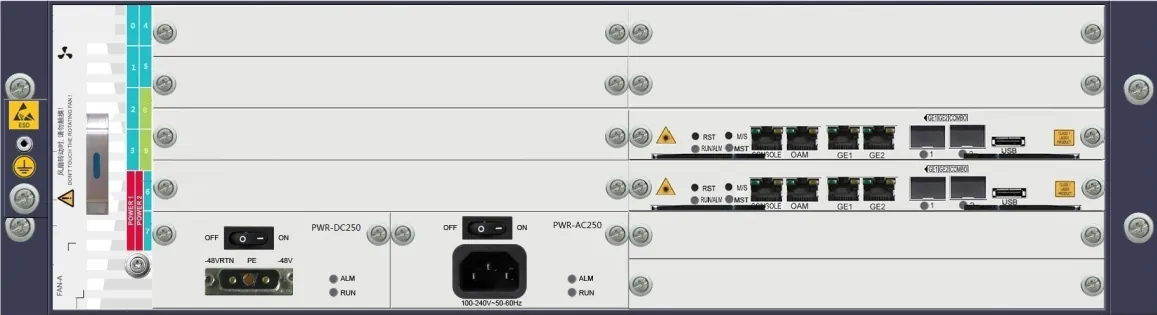
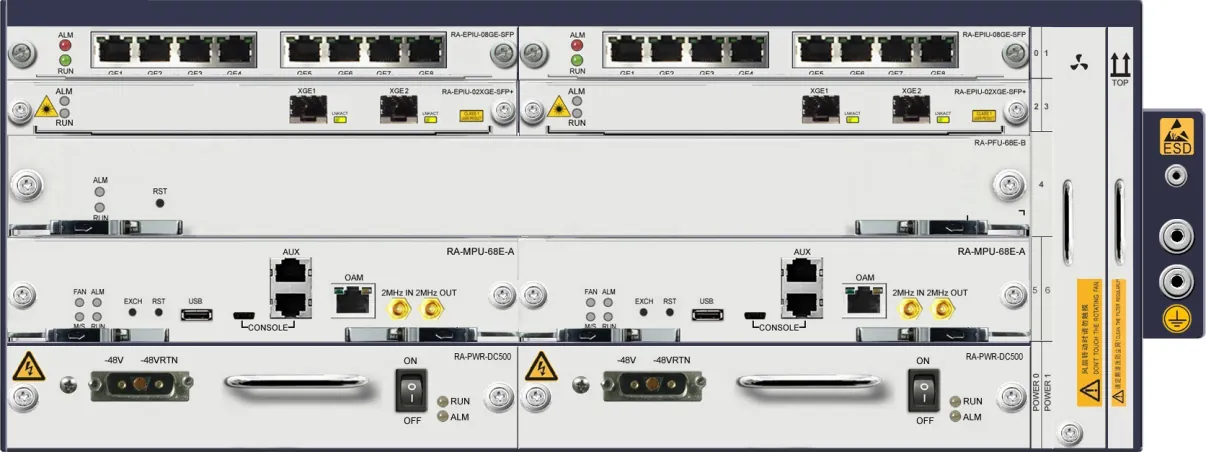
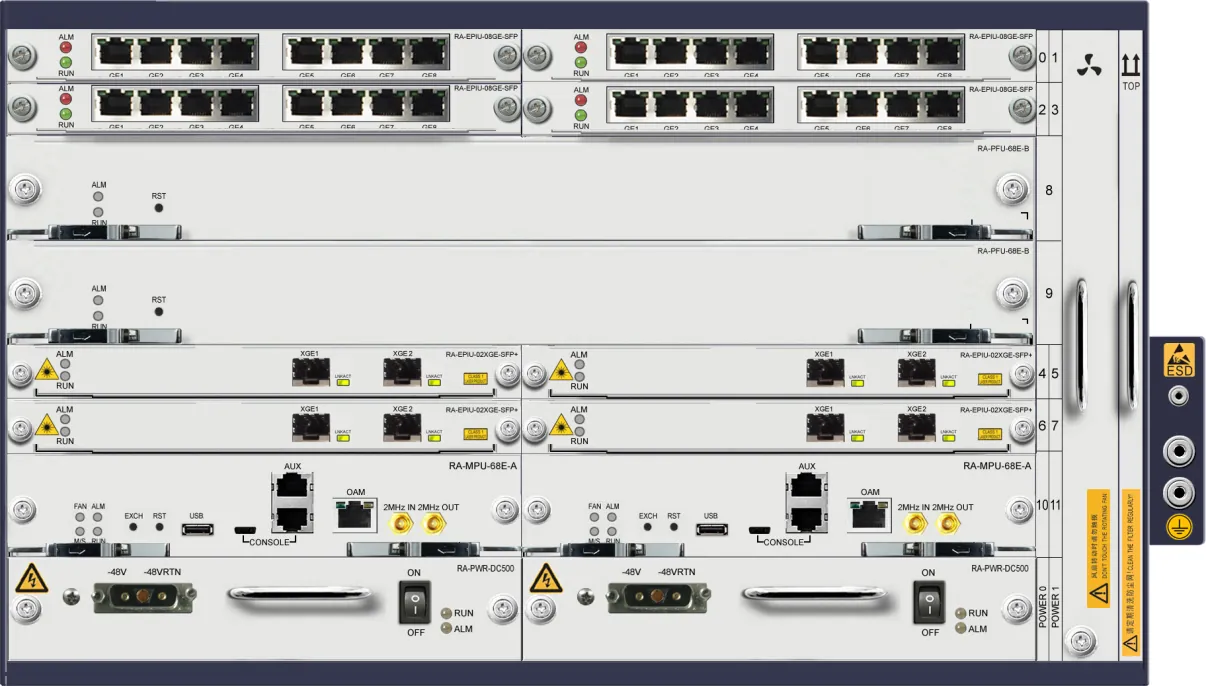
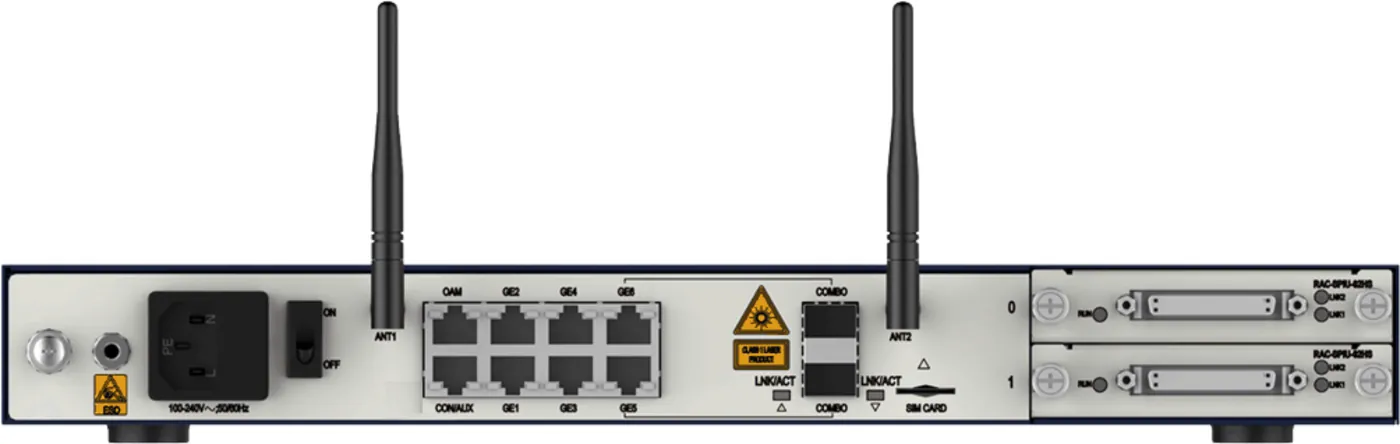
The ZTE Wantong ISG 5800 and ISG 6800 are modular multi-service routers that combine routing, switching, NAT and VPN gateway functions in one chassis. The ISG 5800 (5800-4, 5800-8) is the aggregation family: an ARMv8 multi-core engine, 4 or 8 interface-card slots, two main control/forwarding boards in 1:1, 4G memory, a built-in stateful firewall and an optional SM-crypto encryption card, rated for 1,500–3,000 terminals. The ISG 6800 (6800-4E, 6800-8E) is the core family on ZXROS 5.0: separate control and forwarding planes, 8 fixed 10GE SFP+ ports, hardware ACL acceleration and 10,000 terminals. Both run OSPF, IS-IS, BGP, MPLS L2/L3 VPN, IPSec, DMVPN, GETVPN and SRv6, with 1+1 AC/DC/HVDC power. All specifications below are quoted from the manufacturer's datasheets — where a field was not published, we leave it out rather than guess.
Two families, one routing feature set
How the ISG 5800 aggregation routers and the ISG 6800 core routers split the job.
Is this the right router series for you?
Plain-language guide — based only on what these routers actually do.
- A compact router for a single branch or small office — the ZTE Wantong ISG access routers (ISG 1800-2S / 2800-4 / 3800-8) cover that
- Application-level security such as intrusion prevention or antivirus at the internet edge — the ZTE Wantong ISG F-series next-generation firewalls
- 4G cellular links or rugged hardware for outdoor cabinets and industrial sites — the ZTE Wantong ISG IR industrial routers
Worried about the source? Order under your own company name.
For corporate buyers: we support submitting the purchase order to the manufacturer under your company's real name — your company appears on the official order, so the origin of the goods can be verified directly with the factory. Just provide your company name and pay by corporate bank transfer.
Using your own freight forwarder? No problem.
For small and mid-size orders, we deliver directly to your designated forwarder's warehouse in China — EXW or FOB, your choice, each quoted separately. From hand-over onward, international shipping and destination-side arrangements are handled by your forwarder — the way you already work.
Key Features
The series capability list — from the manufacturer's datasheets.
Who uses it, where it goes and how to plan the router
Written for the ZTE Wantong ISG 5800/6800 routers from their own specifications: 4 modular models with 4 or 8 interface-card slots, dual main control, 1+1 AC/DC/HVDC power, rated for 1,500–3,000 (5800) or 10,000 (6800) terminals.
Who it is for
- Enterprise headquarters IT teams — One router (or a VRRP pair) at the internet edge with NAT, BGP or static routes to two ISPs, policy-based routing between links and HQoS so voice, video and ERP traffic keep their share.
- Government and education networks — Aggregation of many sites over MPLS VPN or IPSec, IPv6 dual stack with transition tools such as NAT64 and 6PE, and SM1–SM4 algorithms where national cryptography is required.
- ISPs and operators — Aggregation of enterprise customers and DCN: IS-IS/BGP, MPLS-TE with FRR, VPLS/VPWS, QinQ, POS/CPOS for SDH and PWE3 (SAToP, CESoPSN) to carry legacy E1 circuits over IP.
- Companies with many branches — The VPN hub at headquarters or a regional office: DMVPN or IPSec tunnels from every branch, OSPF or BGP over the tunnels, and a second unit with VRRP and BFD for failover.
Where and how to install
- 19-inch rack, short depth — All four chassis are 442 mm wide and only 200 mm deep, so they fit shallow wall cabinets as well as full racks. Heights are 88.1 mm (5800-4), 132.0 mm (5800-8), 175 mm (6800-4E) and 264 mm (6800-8E); reserve the rack units before ordering.
- Support the weight — Bare weight is 9 kg, 12.5 kg, 15.5 kg and 22.5 kg. Use rack rails or a shelf, not only the front ears, and keep the heavier 6800 units low in the rack.
- Two power feeds — Feed the two power modules from separate sources: two AC circuits, AC plus UPS, or AC plus the site's -48 V DC plant, since mixed AC and DC redundancy is supported. HVDC 240/336 V modules suit data rooms with high-voltage DC distribution.
- Temperature and airflow — Rated for long-term operation at -5°C to +45°C and 5%–95% humidity without condensation. Fan speed adjusts automatically; keep the air paths clear and avoid closed cabinets without ventilation.
- Console and management access — Each unit has an RJ45 console port (the 6800 adds Mini USB console, AUX and USB per main control card). Use the console or a USB drive for first setup, then manage over SSH, SNMP v3 or the web interface and keep Telnet off on internet-facing links.
ISG 5800 / 6800 planning: which of the 4 models
All four share the same routing, MPLS, VPN, QoS and management feature set; they differ in rated terminal count, number of card slots, fixed 10GE ports, control/forwarding redundancy and power module rating. WAN and LAN ports come from the interface cards fitted. Throughput and forwarding figures are not published in the datasheets.
| 5800-4 | 5800-8 | 6800-4E | 6800-8E | |
|---|---|---|---|---|
| Terminals supported | 1,500–3,000 | 1,500–3,000 | 10,000 | 10,000 |
| Interface-card slots | 4 | 8 | 4 | 8 |
| Fixed 10GE ports | — | — | 8×10GE SFP+ | 8×10GE SFP+ |
| WAN / LAN port types (cards) | 10GE, GE/FE, POS, CPOS, E1/CE1, V.35/V.24 | 10GE, GE/FE, POS, CPOS, E1/CE1, V.35/V.24 | 10GE, GE/FE, POS, CPOS, E1/CE1, V.35/V.24 | 10GE, GE/FE, POS, CPOS, E1/CE1, V.35/V.24 |
| Main control | 2 (1:1, with forwarding) | 2 (1:1, with forwarding) | 2 (1:1) | 2 (1:1) |
| Forwarding cards | on main control board | on main control board | 1 | 2 (1+1) |
| Built-in firewall | stateful | stateful | — | — |
| PSU rating / redundancy | 250 W, 1+1 | 250 W, 1+1 | 500 W, 1+1 | 500 W, 1+1 |
| Height / bare weight | 88.1 mm / 9 kg | 132.0 mm / 12.5 kg | 175 mm / 15.5 kg | 264 mm / 22.5 kg |
| Typical role | HQ egress, branch VPN hub | HQ egress, more cards / legacy links | large enterprise egress, 10G core | network core, full redundancy |
- Pick the ISG 5800-4 for a headquarters or regional hub of up to 1,500–3,000 terminals that needs NAT, a stateful firewall and IPSec/DMVPN to branches with a few interface cards.
- Pick the ISG 5800-8 when the same site also has many E1, serial or SDH links to terminate — 8 slots leave room for TDM and POS/CPOS cards next to Ethernet.
- Pick the ISG 6800-8E for a network core where no single card should stop traffic: two main control cards, two forwarding cards in 1+1 and two power modules, plus 8×10GE SFP+ toward the LAN core.
— = not listed / not applicable. Values are from the page's specification tables. Terminal counts are the manufacturer's rated figures; real capacity depends on traffic, NAT/VPN load and the cards fitted, so send us your user count and link speeds for sizing.
Full Specifications — Model by Model
Series specifications with one column per model — technical values in English. The highlighted column follows your model selection above.
ISG 5800 Aggregation Routers (2 models)
| Item | 5800-4 | 5800-8 |
|---|---|---|
| Dimensions (H×W×D) | 88.1×442×200 mm | 132.0×442×200 mm |
| Terminals supported | 1,500–3,000 | |
| Interface card slots | 4 | 8 |
| Main control / forwarding boards | 2, 1:1 redundancy | |
| Processor | ARMv8 multi-core engine | |
| Memory / Flash | 4 GB / 4 GB | |
| Console | 1×RJ45 | |
| Interface card types | POS: OC-3/STM-1, OC-12/STM-4, OC-48/STM-16 / CPOS: OC-3/STM-1 / Ethernet: 10GE, GE/FE / TDM: E1, CE1 / Sync/async serial: V.35, V.24 | |
| Service card | SM (Chinese national cryptography) data encryption card | |
| Power input | AC: 100–240 V, 50–60 Hz / HVDC: 240 V/336 V (192–400 V) / DC: -48 V | |
| Power redundancy | 1+1 redundant power supplies; mixed AC and DC redundancy supported | |
| PSU module rated power | 250 W | |
| Weight (bare / packed) | 9 kg / 11.5 kg | 12.5 kg / 15.5 kg |
| Operating temperature | -5°C to +45°C (long-term) | |
| Operating humidity | 5%–95%, non-condensing | |
| Energy saving | Intelligent sleep of idle service cards (idle or low-speed ports cut power by 2/3) / intelligent fan speed control / RoHS lead-free manufacturing | |
ISG 6800 Core Routers (2 models)
| Item | 6800-4E | 6800-8E |
|---|---|---|
| Dimensions (H×W×D) | 175×442×200 mm | 264×442×200 mm |
| Terminals supported | 10,000 | |
| Interface card slots | 4 | 8 |
| Fixed service ports | 8×10GE SFP+ (built into the PFU-68E-C2 switching board) | |
| Main control card slots | 2, 1:1 redundancy | |
| Forwarding card slots | 1 | 2, 1+1 redundancy |
| Operating system | ZXROS 5.0 | |
| Console | 1×RJ45 + 1×Mini USB per MPU (main control card) | |
| AUX port | 1 | |
| USB port | 1 per MPU | |
| Interface card types | POS: OC-3/STM-1, OC-12/STM-4, OC-48/STM-16 / CPOS: OC-3/STM-1 / Ethernet: 10GE, GE/FE / TDM: E1, CE1 / Sync/async serial: V.35, V.24 | |
| Power input | AC: 100–240 V, 50–60 Hz / HVDC: 240 V/336 V (192–400 V) / DC: -48 V | |
| Power redundancy | 1+1 redundant power supplies; mixed AC and DC redundancy supported | |
| PSU module rated power | 500 W | |
| Weight (bare / packed) | 15.5 kg / 19 kg | 22.5 kg / 26.5 kg |
| Operating temperature | -5°C to +45°C (long-term) | |
| Operating humidity | 5%–95%, non-condensing | |
| Hardware acceleration | Dedicated hardware ACL acceleration | |
Service Features — All 4 Models
| Item | 5800-4 | 5800-8 | 6800-4E | 6800-8E |
|---|---|---|---|---|
| L2 features | MAC management / VLAN / QinQ / SuperVLAN / Smartgroup / PPP / HDLC / Frame Relay | |||
| IPv4 unicast routing | Static routing / RIPv1/v2 / OSPFv2 / IS-ISv4 / BGP-4 / policy-based routing, routing policy and route load sharing | |||
| IPv4 multicast | IGMPv1/v2/v3 / static multicast / PIM-DM, PIM-SM, PIM-SSM / MSDP / MBGP / multicast VPN / multicast load sharing | |||
| NAT | Static/dynamic NAT / PAT / VRF NAT / ALG | |||
| DHCP | DHCP Server / DHCP Relay / DHCPv6 Server / DHCPv6 Relay | |||
| IPv6 unicast routing | Static routing / RIPng / OSPFv3 / IS-ISv6 / BGP4+ / policy-based routing, routing policy and route load sharing | |||
| IPv6 multicast | MLDv1/v2 / static multicast / PIM-DM, PIM-SM, PIM-SSM / MBGP | |||
| IPv6 transition | 6in4 / 6to4 / 4in6 / 6 over 4 / 6PE / NAT64 / 6rd / ISATAP | |||
| QoS | Traffic classification, marking, priority inheritance and mapping / traffic shaping and rate limiting / PQ, WFQ, CBWFQ, LLQ and per-port scheduling / time-based QoS / HQoS | |||
| MPLS | Static LSP / LDP / MPLS-TE / RSVP-TE / LDP FRR / TE FRR / MPLS L2VPN / MPLS L3VPN / PWE3 / 6VPE | |||
| VPN | MPLS L2VPN (VPWS, VPLS) and MPLS L3VPN / GRE / IPSec VPN / DMVPN / GETVPN / L2TP / 6VPE | |||
| PWE3 circuit emulation | SAToP and CESoPSN encapsulation | |||
| Reliability | Redundant main control and power / hot-swappable boards / link aggregation / BFD for everything / FRR / VRRP / link redundancy backup / pseudowire redundancy / 99.999% system availability (carrier class) | |||
| Firewall | Built-in: packet filtering and stateful inspection | Built-in: packet filtering and stateful inspection | Not listed | Not listed |
| Security | Port mirroring / NetFlow V5/V8/V9 / SM1, SM2, SM3, SM4 national-crypto algorithms / data plane: ACL filtering, URPF / control plane: CPU protection, anti-DoS, routing security / management plane: account and password security, RADIUS/TACACS+ AAA, logging, device access security | |||
| SDN | VXLAN / EVPN / NETCONF / SR / SRv6 | |||
| Management & OAM | Web management / SNMPv1/v2/v3 / alarm management, performance statistics, clock and clock synchronization management, Syslog / Telnet, SSHv1/v2 / USB software upgrade, batch upgrade from NMS / Ethernet OAM, MPLS OAM, SQA (service quality analysis), EEM | |||
Aggregation & Core Router FAQ — ISG 5800 / 6800
ISG 5800 or ISG 6800 — which family should I choose?
4 slots or 8 slots — how do I decide?
Which VPN types can I use to connect many branches to one ISG router?
What redundancy do these routers have inside one chassis?
Can these routers run on -48 V DC in a telecom room or on site power?
Can I order under my own company name and use my own forwarder?
Do I still need a separate firewall with these routers?
Will the ISG 5800/6800 work with Cisco, Huawei or H3C routers at the other end?
Can these routers help us move to IPv6 gradually?
How quickly can a new site be brought online, and how are upgrades handled?
Can the router carry old E1 or serial services while we move to IP?
Can I order one unit first, and how does it reach my country?
How do I pay?
Related Products

Request a quote for this product
An engineer replies within 24 hours on working days with model check, price and lead time. No obligation, no newsletters.
Product: ZTE Wantong ISG 5800 / 6800 · Aggregation & Core Routers