
ZTE Wantong ISG 1800 / 2800 / 3800 · Access Routers
Access routers that combine routing, switching, firewall, VPN and NAT gateway in one unit, for internet egress, head-office and branch access, financial outlets and mobile offices — three models sized for 300–500, 500–800 and 800–1,500 users, with 3G/LTE, E1, serial, POS and 10GE interface options. We deliver them configured as part of the network solutions we build.
Lead time · In stock: at your forwarder’s China warehouse 3 days after payment · Not in stock: 7–15 working days · Then air 5–10 days / sea 25–45 days to your port
Terms · Sample orders welcome · Quotation / PI fixes models, prices, Incoterms (EXW or FOB, each quoted separately), lead time and T/T payment · Defective units: free spare units agreed per order (quantity depends on order size) and written into the quotation · Warranty: up to 5 years on Zhongxin Shutong industrial switches, manufacturer warranty on other brands · Full terms, warranty & RMA
Need the PDF datasheet? Get it on WhatsApp →Sample quantities are welcome — testing one or two units first is the normal way to start.
The ZTE Wantong ISG 18/28/38 series is a family of next-generation access routers that put routing, switching, wireless access, firewall and VPN gateway in one box. The three models — ISG 1800-2S, ISG 2800-4 and ISG 3800-8 — are sized for 300–500, 500–800 and 800–1,500 users and serve as the internet gateway of an enterprise, the access router of a head office or branch, a financial outlet or mobile office, or an aggregation/access router in an industry network. They run a multi-core CPU, offer many fixed GE ports, take E1, serial, POS, 10GE and 3G/LTE cards, and support IPSec, DMVPN, GETVPN, L2TP, GRE and MPLS VPN, NAT, H-QoS and IPv6. All specifications below are quoted from the manufacturer's document; no throughput or session figures are published, so we do not quote any.
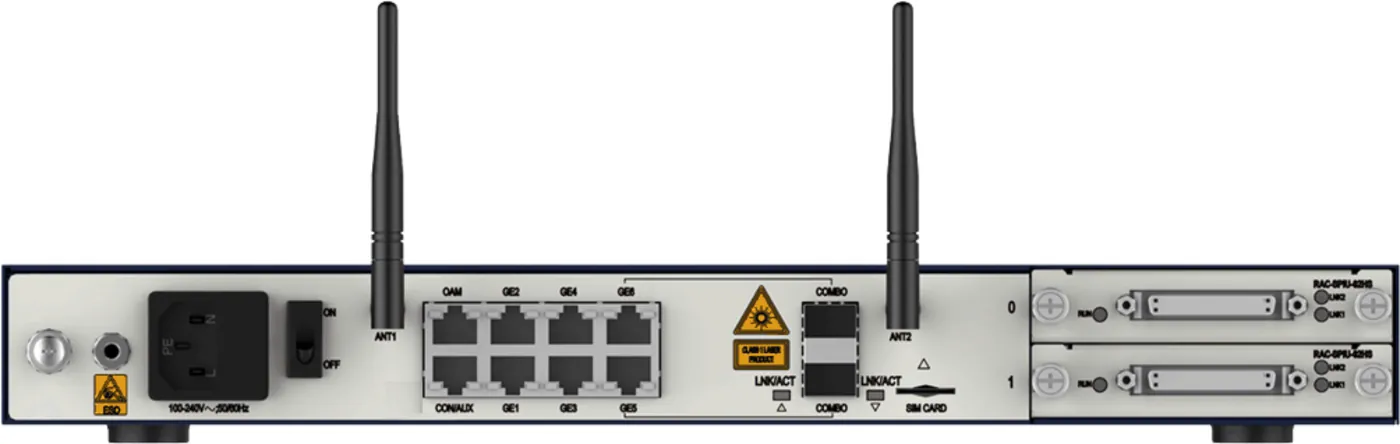
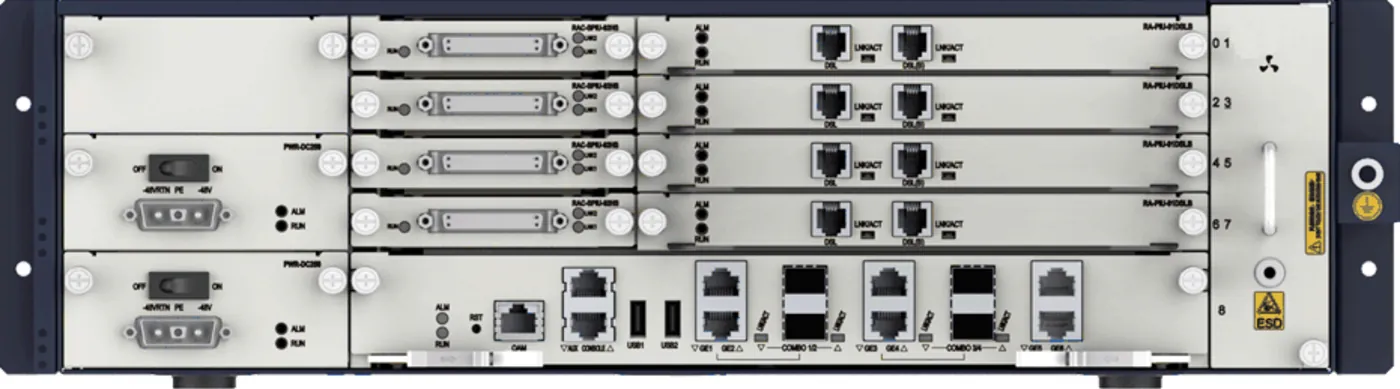
Compact branch router and two modular chassis
How the 1800-2S differs from the 2800-4 and 3800-8 — same software features, different slots, interfaces and power.
Is this the right router series for you?
Plain-language guide — based only on what these routers actually do.
- Aggregation or core routing for many branches or a regional backbone — the ZTE Wantong ISG 5800/6800 aggregation and core routers sit above this series
- A small DIN-rail or cabinet router with a SIM for outdoor poles, solar CCTV or machines — the ZTE Wantong ISG IR industrial routers (IR111/112/121/122/520/530)
- Dedicated next-generation firewall inspection or PoE power for cameras — the ZTE Wantong ISG F-series firewalls, and PoE access switches such as the S5160-HE series
Worried about the source? Order under your own company name.
For corporate buyers: we support submitting the purchase order to the manufacturer under your company's real name — your company appears on the official order, so the origin of the goods can be verified directly with the factory. Just provide your company name and pay by corporate bank transfer.
Using your own freight forwarder? No problem.
For small and mid-size orders, we deliver directly to your designated forwarder's warehouse in China — EXW or FOB, your choice, each quoted separately. From hand-over onward, international shipping and destination-side arrangements are handled by your forwarder — the way you already work.
Key Features
The series capability list — from the manufacturer's document.
Who uses it, where it goes and how to plan the access router
Written for the ZTE Wantong ISG 18/28/38 series from its own specifications: 3 models for 300–500, 500–800 and 800–1,500 users, GE Combo and RJ45 ports, 2 to 10 card slots, 3G/LTE, E1, serial, POS and 10GE options, single or 1+1 power.
Who it is for
- SMEs and branch offices — One router as the office gateway: NAT and stateful firewall for internet access, DHCP server for the LAN, IPSec or DMVPN back to head office, and H-QoS so calls and video meetings keep priority.
- Chain stores, schools and bank outlets — Many similar sites on one template: USB-drive or SMS deployment to bring each router up, DMVPN or GETVPN to the centre, 3G/LTE with SDC as backup, and NMS batch upgrades from head office.
- ISPs delivering enterprise lines — A CPE that terminates fibre, E1, serial or POS lines and carries MPLS L2/L3 VPN, PWE3, BGP and IS-IS, with Eth OAM, MPLS OAM, SQA and NetFlow for monitoring the service.
- CCTV and security integrators — The router at a camera site for remote viewing: static NAT or PAT to publish the NVR, or better an IPSec VPN to the monitoring centre, with QoS for video and an LTE link as backup where fibre is unreliable.
Where and how to install
- Rack or shelf — The 2800-4 and 3800-8 are 442 mm wide (19-inch) and 88.1 mm and 132.0 mm high, 200 mm deep, so they fit a standard rack or a wall cabinet. The 1800-2S is 380 mm wide and 43.6 mm high — place it on a shelf or ask us about mounting parts for your cabinet.
- Power feeds — The 1800-2S runs on AC 100–240 V or DC -48 V with one supply, so put it on a UPS. On the 2800-4 and 3800-8 fit both supplies and feed them from two sources — for example mains AC and a -48 V DC or 240/336 V HVDC plant, since mixed AC and DC is allowed.
- Temperature and airflow — Rated -5°C to +45°C and 5%–95% humidity, non-condensing. Fans adjust their speed automatically; keep the air paths open and avoid closed cabinets in direct sun. For hot outdoor cabinets an industrial router is the better fit.
- WAN lines and cards — Fibre internet goes into a GE Combo port with an SFP module; copper lines use the RJ45 side. E1, V.35/V.24 serial, POS/CPOS and 3G/LTE need the matching interface card in a free slot, and POS/CPOS and 10GE cards are listed only for the 2800-4 and 3800-8.
- Antennas and SIM — With the 1800-2S(G) or a 3G/LTE card, check signal at the exact install point before mounting; place the router or the antenna lead where the signal is best, away from metal cabinet walls.
ISG access router planning: which of the 3 models
All three run the same software features (routing, VPN, NAT, QoS, firewall, IPv6, MPLS); they differ in users supported, fixed ports, card slots, interface cards and power. The manufacturer publishes no throughput or session figures, so size by recommended users and interfaces. Total slots is the sum of SPIU, PIU and DPIU slots.
| 1800-2S | 2800-4 | 3800-8 | |
|---|---|---|---|
| Recommended users | 300–500 | 500–800 | 800–1,500 |
| Fixed WAN/LAN ports | 2×GE Combo + 4×GE RJ45 | 4×GE Combo + 4×GE RJ45 | 8×GE Combo |
| 10GE | — | by card | 2×10GE version listed; or by card |
| Built-in wireless | Wi-Fi (W) or 3G/LTE (G) version | — | — |
| Slots SPIU / PIU / DPIU | 2 / 0 / 0 | 2 / 2 / 1 | 4 / 4 / 2 |
| Total slots | 2 | 5 | 10 |
| WAN line cards | GE/FE, E1/CE1, V.35/V.24, 3G/LTE | + 10GE, OC-3/STM-1 POS/CPOS, OC-12/STM-4 POS | + 10GE, OC-3/STM-1 POS/CPOS, OC-12/STM-4 POS |
| Flash / memory | 1 GB / 2 GB | 4 GB / 2 GB | 4 GB / 2 GB |
| Power | single, AC or -48 V DC, 60 W | 1+1, AC/HVDC/-48 V DC, 250 W | 1+1, AC/HVDC/-48 V DC, 250 W |
| Height × width | 43.6 × 380 mm | 88.1 × 442 mm | 132.0 × 442 mm |
| Typical role | branch, store, outlet gateway | head office / large branch | head office / aggregation access |
- Pick the 1800-2S(G) for a branch or camera site where 3G/LTE is the main or backup link and one power supply is acceptable; the 1800-2S(W) adds built-in Wi-Fi for a small office.
- Pick the 2800-4 when the site needs redundant power, POS/CPOS or 10GE cards, or more than two interface cards, for 500–800 users.
- Pick the 3800-8 for 800–1,500 users or a head office that terminates many lines: eight GE Combo ports, a listed 2×10GE version and 10 slots in total.
— = not listed / not applicable. Values are from the page's specification tables; total slots is our arithmetic (SPIU + PIU + DPIU). Recommended users is the manufacturer's 带机量 (devices behind the router). No throughput, NAT session or VPN tunnel figures are published for this series.
Full Specifications — Model by Model
Series specifications with one column per model — technical values in English. The highlighted column follows your model selection above.
Hardware — All 3 Models
| Item | 1800-2S | 2800-4 | 3800-8 |
|---|---|---|---|
| Recommended users | 300–500 | 500–800 | 800–1,500 |
| Fixed interfaces | 2×GE Combo + 4×GE RJ45 | 4×GE Combo + 4×GE RJ45 | 8×GE Combo; 2×10GE + 8×GE Combo version listed |
| Built-in wireless versions | 1800-2S(W): built-in Wi-Fi; 1800-2S(G): built-in 3G/LTE | 3G/LTE via interface card | 3G/LTE via interface card |
| Console / AUX | 1×CON, 1×AUX | ||
| Memory | 2 GB | ||
| Flash | 1 GB | 4 GB | 4 GB |
| SPIU slots | 2 | 2 | 4 |
| PIU slots | 0 | 2 | 4 |
| DPIU slots | 0 | 1 | 2 |
| Interface cards | GE/FE, E1/CE1, V.35/V.24, 3G/LTE, SM cryptography card | 10GE/GE/FE, E1/CE1, OC-3/STM-1 POS/CPOS, OC-12/STM-4 POS, 3G/LTE, SM cryptography card | 10GE/GE/FE, E1/CE1, OC-3/STM-1 POS/CPOS, OC-12/STM-4 POS, 3G/LTE, SM cryptography card |
| Tiered service engines | — | Supported (purchased as needed) | Supported (purchased as needed) |
| Dimensions (H×W×D) | 43.6×380×200 mm | 88.1×442×200 mm | 132.0×442×200 mm |
Power & Environment — All 3 Models
| Item | 1800-2S | 2800-4 | 3800-8 |
|---|---|---|---|
| Power input | AC 100–240 V; DC -48 V | AC 100–240 V; HVDC 240 V/336 V (192–400 V); DC -48 V | AC 100–240 V; HVDC 240 V/336 V (192–400 V); DC -48 V |
| Power supply | Single power supply | 1+1 redundant, mixed AC and DC supply | 1+1 redundant, mixed AC and DC supply |
| Rated power | 60 W | 250 W | 250 W |
| Hot swap | — | Power supplies, fans and boards | Power supplies, fans and boards |
| Cooling | Fans with smart speed control (low-noise design) | ||
| Operating temperature | -5°C to +45°C | ||
| Storage temperature | -40°C to +70°C | ||
| Operating humidity | 5%–95% (non-condensing) | ||
| Storage humidity | 5%–95% (non-condensing) | ||
| Energy saving | Smart board sleep, idle service cards powered down; idle or low-speed ports use 2/3 less power | ||
Software Features — All 3 Models
| Item | 1800-2S | 2800-4 | 3800-8 |
|---|---|---|---|
| Layer 2 | MAC management / VLAN / QinQ / SuperVLAN / Smartgroup / PPP / PPPoE / HDLC / FR / 802.1x | ||
| IPv4/IPv6 routing | Static routing / RIP / RIPng / OSPF / OSPFv3 / IS-IS / IS-ISv6 / BGPv4 / BGP4+ | ||
| Multicast | Static multicast / IGMP v1/v2/v3 / IGMP Snooping / PIM-DM / PIM-SM / PIM-SSM / MSDP / PIM-SSM mapping / MLD v1/v2 / MLD Snooping | ||
| DHCP | DHCPv4/v6 relay / DHCPv4/v6 server / DHCPv4/v6 snooping | ||
| 3G/LTE | TD-SCDMA / WCDMA/HSPA+ / TDD LTE / FDD LTE | ||
| MPLS | Static LSP / LDP / MPLS-TE / RSVP-TE / LDP FRR / TE FRR / MPLS L2 VPN / MPLS L3 VPN / PWE3 / 6VPE | ||
| VPN | GRE / IPSec VPN / DMVPN / GETVPN / L2TP / MPLS L2 VPN / MPLS L3 VPN / 6VPE | ||
| IPv6 transition | 6in4 / 6to4 / 4in6 / 6 over 4 / 6PE / NAT64 / 6rd / ISATAP | ||
| NAT | Static NAT / dynamic NAT / PAT / multiple NAT exits / NAT ALG / NAT logs | ||
| QoS | H-QoS / time-based QoS / traffic classification / marking / priority inheritance and mapping / traffic shaping / rate limiting / PQ / WFQ / CBWFQ / LLQ / per-physical-port scheduling | ||
| Security | Stateful firewall / control-plane security / IPSec / IKE / anti-ARP attack / anti-DoS/DDoS / RADIUS and TACACS+ authentication / 802.1x authentication / ACL / port mirroring / URPF / SSH / SM1, SM2, SM3, SM4 algorithms | ||
| Reliability | Redundant power design / hot-swap power, fans and boards / BFD for everything / VRRP / link aggregation / FRR / pseudowire redundancy / SDC smart dial control / link redundancy backup | ||
| OAM & management | USB deployment / SMS deployment / NMS unified version upgrade / temperature monitoring / automatic fan speed / Eth OAM / MPLS OAM / SQA / NetFlow v5/v8/v9 / Web management / SNMP v1/v2/v3 / Telnet / SSH v1/v2 / Syslog / EEM | ||
| SDN WAN | VXLAN / VXLAN over IPSec / VXLAN over GRE / EVPN / NETCONF | ||
Access Router FAQ — ZTE Wantong ISG 1800 / 2800 / 3800
Which ISG model should I choose for my site?
Can the router fall back to 4G/LTE when the fibre line goes down?
Which VPN types can connect my branches to head office?
What is the difference in power and redundancy between the 1800-2S and the larger models?
Is the series ready for IPv6 and SDN WAN?
Can I order under my own company name and use my own forwarder?
How do I view my CCTV remotely through an ISG router?
Why is there no throughput figure, and how do I size the router?
Does it work with Huawei, H3C or Cisco routers at the other end?
Can I configure and manage it without the command line?
Can these routers terminate E1 or older serial leased lines?
Can I order one unit first, and how does it reach my country?
How do I pay?
Related Products

Request a quote for this product
An engineer replies within 24 hours on working days with model check, price and lead time. No obligation, no newsletters.
Product: ZTE Wantong ISG 1800 / 2800 / 3800 · Access Routers